
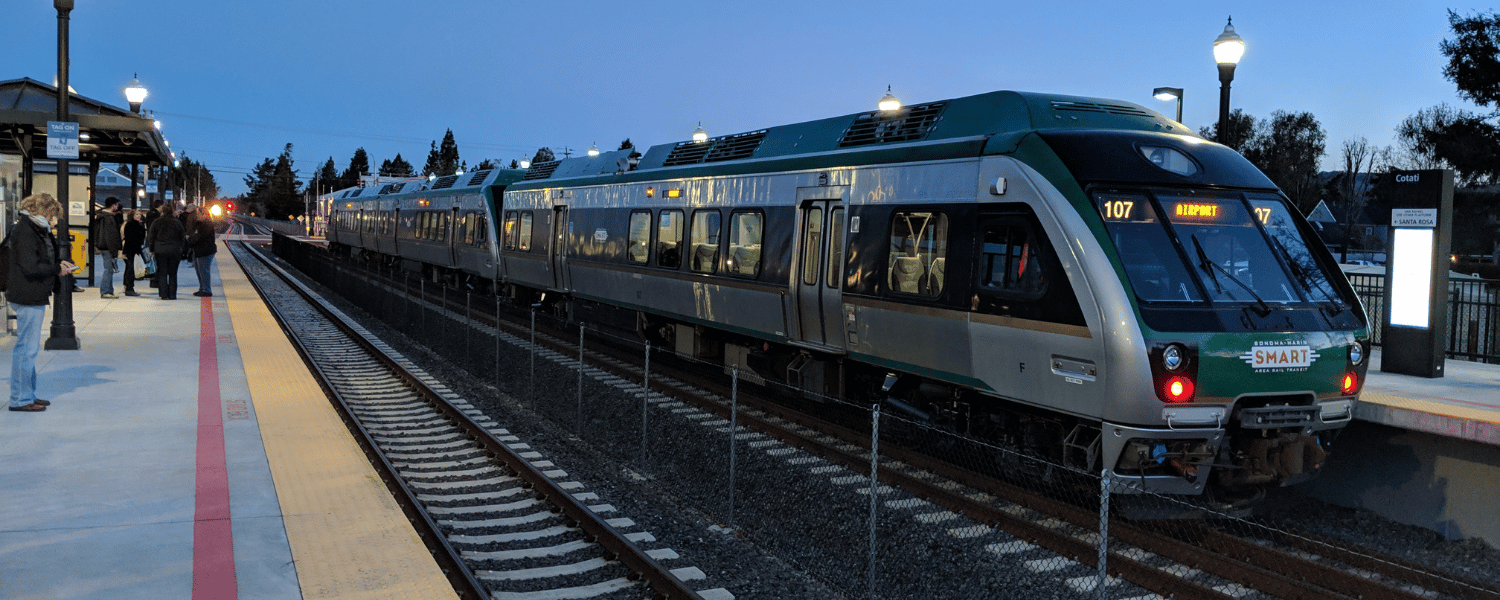
Geyserville station
SMART is working to complete the passenger rail and pathway system approved by North Bay voters in 2008, connecting Cloverdale and Larkspur. As part of that effort, the agency is evaluating a proposed station in Geyserville while advancing the final northern extension of passenger rail service to Cloverdale. Community input will help determine whether a station should be included in Geyserville and where it should be located.
Project Overview
SMART is actively pursuing funding to restore passenger rail service from Healdsburg to Cloverdale. As part of that effort, the agency is evaluating whether a station in Geyserville should be included as part of the northern extension.
The proposed station would:
-
Provide train access for Geyserville residents, workers, and visitors
-
Increase transportation options in northern Sonoma County
-
Improve connectivity between rail, transit, walking, and bicycling
-
Support completion of the voter-approved passenger rail system to Cloverdale
-
Return passenger rail service to Geyserville for the first time in nearly 70 years
Background
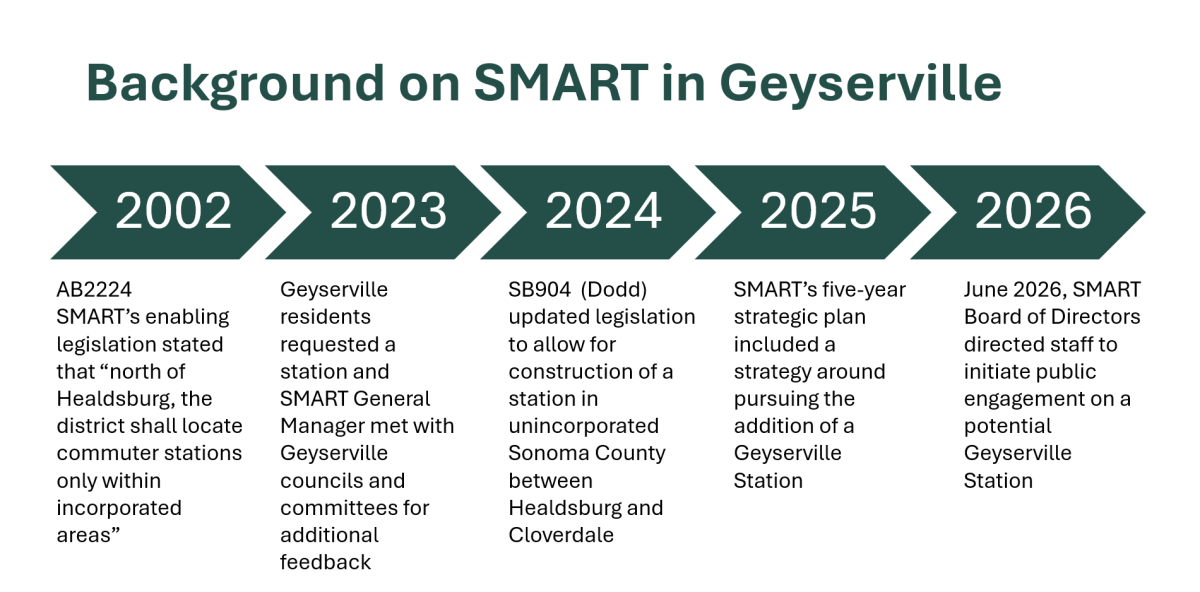
SMART's original enabling legislation limited stations north of Healdsburg to incorporated areas. In response to local community interest, state legislation was updated in 2024 to allow SMART to construct a station in unincorporated Sonoma County between Healdsburg and Cloverdale.
In 2025, SMART's Five-Year Strategic Plan included a strategy to explore the addition of a station in Geyserville. The Strategic Plan also reaffirmed SMART's commitment to completing the full passenger rail system approved by voters in 2008, extending service from Larkspur to Cloverdale.
Building on that effort, the SMART Board of Directors directed staff in June 2026 to begin public engagement on a potential station in Geyserville.
Evaluating a Geyserville station does not change the agency's long-term goal of restoring passenger rail service to Cloverdale. Rather, it helps position SMART to pursue funding opportunities that will support completion of the full northern extension.
(click image to enlarge)
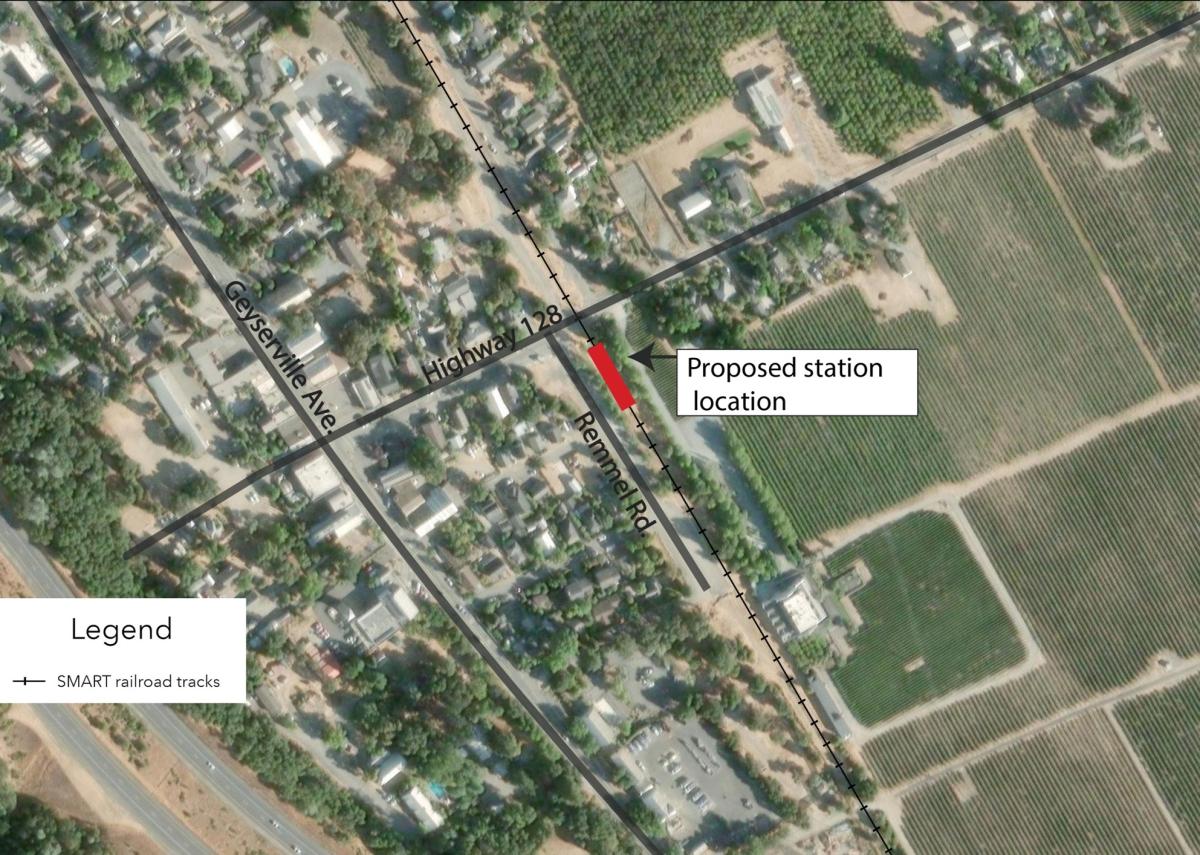
Proposed Station Location
(click image to enlarge)
SMART is evaluating a location near Highway 128 and Remmel Road.
Potential benefits of this location include:
- Centrally located near housing, jobs, and businesses
- Located within SMART's existing railroad right-of-way
- Within the Geyserville Urban Service Area
- Less than one-quarter mile from connecting transit services
- Space available to locate vehicle parking and other station amenities
If constructed, the station could include:
- Passenger boarding platform
- Covered shelter and passenger amenities
- Bicycle parking
- Vehicle parking (capacity to be determined)
- Bikeshare
- Opportunities for transit connections and first/last-mile access
Quiet Zones
Federal regulations require SMART’s engineers to sound the train horn when approaching at-grade crossings of SMART’s track and a public or private roadway, or a pathway. Federal regulations also allow cities, towns, and counties (local jurisdictions) to establish Quiet Zones, which are specific sections of a railroad where routine use of the train horn at grade crossings is prohibited, with certain exceptions.
The process to establish a Quiet Zone involves the local jurisdiction(s) working together with the Federal Railroad Administration to demonstrate that federally-required safety criteria are met prior to establishing a Quiet Zone. To reach this point, the local jurisdiction(s), California Public Utilities Commission, Federal Railroad Administration, and SMART review each crossing. The local jurisdictions and regulatory staff confirm that the appropriate improvements—such as upgraded gates, warning devices, or features like roadway medians are in place to ensure that each crossing remains equally safe without the routine use of the train horn. Once all requirements are met, the Quiet Zone can be formally established by the local jurisdiction via Federal Railroad Administration approval.
Once a Quiet Zone is approved and established, routine train horn use at designated grade crossings within the Quiet Zone is prohibited, except in emergency or safety-critical situations, such as emergencies, a vehicle stopped on the track, SMART maintenance personnel or a trespasser near the track, a grade crossing malfunction, such as a broken gate arm or equipment failure, during testing, and/or at the train engineer’s discretion.
While routine use of the train horn at grade crossings is prohibited within a Quiet Zone, the use of the bell onboard the train, and bells on the grade crossing warning equipment is still required. Within an established Quiet Zone, the public will hear the bell onboard the train at grade crossings and the bells located at grade crossings.