
Healdsburg Station Location
Where should the SMART Healdsburg station be located?
SMART is bringing passenger rail service back to Healdsburg for the first time in nearly 70 years. As planning advances, SMART is seeking public input on an important question: Where should the Healdsburg SMART station be located?
A station is a long-term investment, and its location can shape how people use it for decades to come. Proximity to homes, jobs, and destinations, as well as connections to buses, walking, bicycling and the regional road network, can all influence how convenient the train is for residents, workers, and visitors. However, a station can also spur high density housing and mixed-use development increasing use and ridership over time.
The Healdsburg station will serve both the local community and people traveling throughout the SMART system. Whether you live in Healdsburg, or plan to utilize the train to travel to or from Healdsburg for work, school, shopping, dining or recreation, we want to hear from you.
Please take a few minutes to complete the survey using the link below and share your thoughts. Your feedback will help SMART better understand community travel needs and preferences as we evaluate potential station locations.
We encourage everyone with an interest in the future of rail service in Healdsburg to participate in the survey. Your feedback will help inform this decision by sharing your travel needs and identifying which station location would best serve the Healdsburg community and future SMART riders.
Two locations are being considered
- Depot/Hudson
- Vine/West Plaza/Downtown
The two locations are approximately 0.45 miles apart, but they have different characteristics related to surrounding land uses, sidewalk access, bus transit and local transportation connections, parking, future development opportunities and proximity to homes, jobs and destinations.
 |
 |
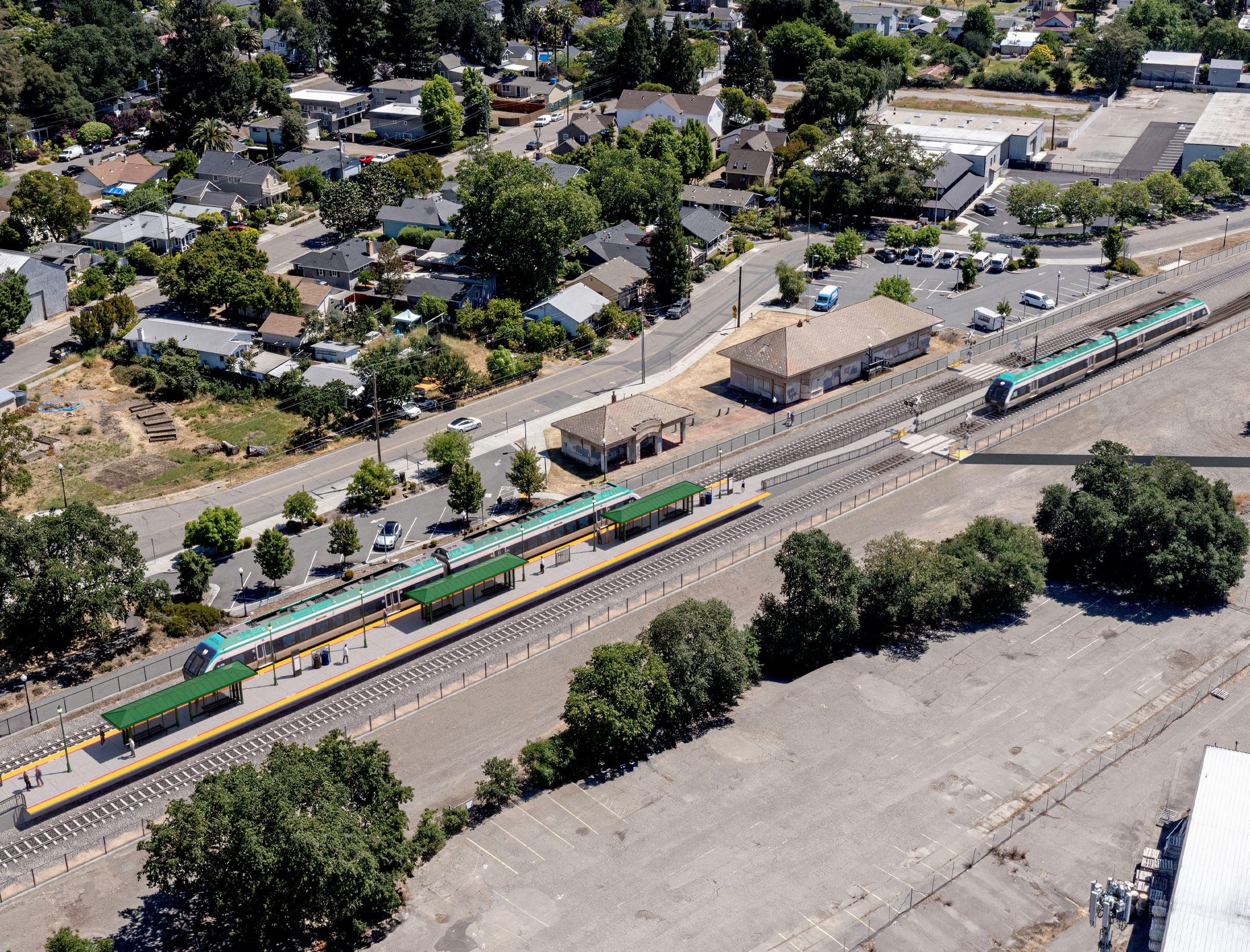
Depot/Hudson Location
- Proximity to the historic depot, residential areas and destinations in south Healdsburg: The Depot/Hudson site is adjacent to Healdsburg’s historic rail depot and approximately 0.38 miles, or an eight-minute walk, from the Healdsburg Plaza. The location is near established residential neighborhoods, as well as businesses, schools, and visitor destinations in south Healdsburg.
- Greater flexibility for station facilities: The site has more land available immediately surrounding the proposed station, providing greater flexibility for station facilities such as bike lockers and currently has 48 parking spaces.
- Greater opportunity for high-density housing development: It is also located near more of the City’s undeveloped land that is identified for future high-density housing and mixed-use development.
- Consistent with existing City planning direction: The site has been assumed as the SMART station location in previous City planning efforts and is included in the City’s Station Area Specific Plan planning area. The City Council identified Depot/Hudson as its preferred location in February 2024 and reaffirmed that preference in September 2026.
- Fewer existing destinations nearby: The site is farther from the Plaza and currently has fewer established commercial, employment, dining, and visitor destinations within walking distance.
- Ridership and growth depend on development build-out: Future station-area development could increase the number of destinations and activity near the station over time, however, that will depend on future land-use decisions, private investment, infrastructure capacity, and market conditions.
- Bus connections would require improvements: Improvements to local and regional bus service connections and other transportation access would be needed to support convenient connections to and from the station.
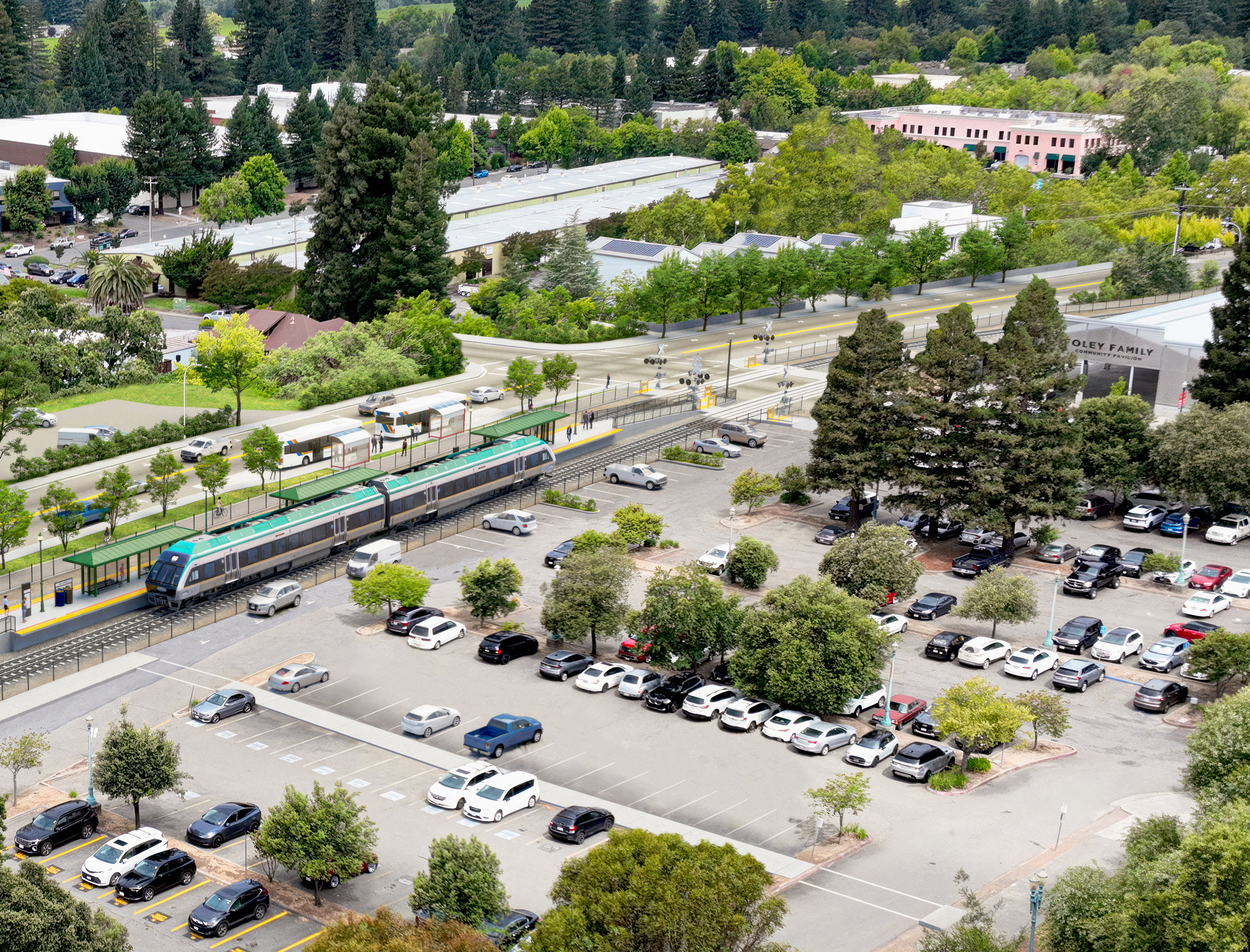
Vine/West Plaza/Downtown Location
- Proximity to Healdsburg Plaza and downtown destinations: The Vine/West Plaza/Downtown site is located on Vine Street between North Street and Matheson Street, adjacent to the West Plaza parking lot and approximately 0.2 miles, or a four-minute walk, from the Healdsburg Plaza.
- Integration with existing downtown environment: The station would operate within an active downtown environment where train service would be integrated with existing vehicle, pedestrian, bicycle, bus, parking, and other activity.
- Potential to serve existing travel activity: Its location is within the established downtown area where a greater amount of trips beginning or ending in Healdsburg occur, which the train could alternatively serve, while providing opportunities to connect with existing local and regional bus services.
- Proximity to jobs, businesses, and services: The site would place rail service closer to a greater concentration of existing jobs, businesses, schools, services, and daily activity in downtown Healdsburg.
- More limited space for station facilities and parking: With more limited space for station facilities and parking, the station design would require changes to portions of the West Plaza parking area and other existing public spaces, including removal of some trees to accommodate station operations and the multiuse pathway.
- Less flexibility for future station-area development: The amount of undeveloped land near the site is limited, which may constrain opportunities for larger-scale station-area development, although redevelopment, infill, and other forms of development could occur over time
View Recent Presentations
Learn more about the proposed Healdsburg SMART station locations by viewing presentation materials from recent meetings of the SMART Board of Directors and Healdsburg City Council.
SMART Board of Directors — September 16, 2026
Healdsburg City Council — September 21, 2026 (presentation on page 32)
Community Meeting at Healdsburg High School - October 22, 2026
Public Comments Received
Take the Survey
We want to hear from you. Please take a few minutes to complete the survey and share your thoughts on the future location of the Healdsburg SMART station. Your input will help inform this important decision.
| Take the survey in English | Responda a la encuesta en español |
Frequently Asked Questions
- Why does proximity to destinations, jobs, and bus transit matter when the walk difference is between 4 minutes and 8 minutes?
When individuals make travel decisions, they primarily weigh whether the mode of travel will allow them to comfortably get to where they want to go and if it will get them there on time. Proximity, reliability, and perceived safety and comfort matters. If sidewalks are narrow, crowded, or have obstacles like missing curb ramps, people may perceive their experience as more challenging and less comfortable.
- Which station location will have higher ridership?
Ridership estimates were developed through planning studies in 2006 and 2008 and the Healdsburg Depot location was estimated to have 413 boardings per day. Today, the SMART system is carrying a weekday average of around 5,800, approximately 15% higher than the full SMART system ridership projection of 5,046, with 25% of today’s riders being youth under 18 years old.
While ridership estimating is based on a wide range of characteristics, real world examples on the SMART system can be compared to each location in Healdsburg. In particular, the comparison of ridership at the three Novato SMART stations is a real world look at walkability and density. Downtown Novato today carries approximately 37% more riders than Novato Hamilton and 89% more riders than Novato San Marin.
Given how people make decisions about travel, demonstrated trip making today and the job and residential density patterns in Healdsburg, the Vine/Downtown station location would maximize the ridership of SMART systemwide. Maximizing ridership on the SMART system is necessary to improve SMART’s outlook of successfully competing for additional grant funds to complete the rail and path system to Geyserville and Cloverdale.
- Is there a difference in the traffic impact between the two locations?
Train movement will affect the roundabout and rail crossings in Healdsburg, including through Downtown, as trains travel to Geyserville and Cloverdale, regardless of the station’s location. For passage of a single train, crossing warning devices at the roundabout will activate for approximately 60 seconds. Some scenarios will result in longer warning device activation periods, such as when northbound and southbound trains meet at the station. SMART’s grade crossing warning systems are designed to provide a minimum of 25 seconds of warning time, measured from the time the lights start flashing and bells sound until the train reaches the crossing. Additional warning time is provided at grade crossings with specific physical characteristics, such as multiple tracks, or skewed roadway and track geometry.
If the Healdsburg station is located at the Depot/Hudson site, through trains will travel through Matheson Street and North Street at speeds between 25 and 35 miles per hour. Total warning system activation times at both Matheson Street and North Street are anticipated to be approximately 1 minute, with the actual time dependent on actual train speed and train handling once the warning devices are activated.
If the Healdsburg station is located at the Downtown/Vine Street location, the train operation would have Northbound trains approaching Matheson Street at a speed of approximately 25 miles per hour and stopping at the station platform prior to North Street. Total activation time for Matheson in this case is anticipated to be approximately 1 minute.
During a portion of the time that the train is stopped at the station, the warning system at North Street will remain inactive, allowing roadway and pedestrian traffic to continue to flow and clear the crossing. Once the train has completed its normal dwell, the warning system at North Street will be activated, and the train will depart the station. Total activation time at North Street in this scenario is anticipated to be approximately 1 minute but could be longer dependent on the actual speed of the departing train, and the actual length of the train’s dwell at the station.
Southbound trains would approach North Street at a speed of approximately 25 miles per hour and will come to a stop at the station platform prior to Matheson Street. Total activation time for North Street in this case is anticipated to be approximately 1 minute.
During a portion of the time that the train is stopped at the station, the warning system at Matheson Street will remain inactive, allowing roadway and pedestrian traffic to continue to flow and clear the crossing. Once the train has completed its normal dwell, the warning system at Matheson Street will be activated, and the train will depart the station. Total activation time at Matheson Street in this scenario is anticipated to be approximately 1 minute but could be longer dependent on the actual speed of the departing train, and the actual length of the train’s dwell at the station
Regardless of the station location, the new traffic signals that will be installed at Matheson Street and North Street will be designed to clear all motor vehicles and pedestrians/bicyclists from the track prior to the warning devices activating.
More than 800 daily passenger trips are expected to and from the SMART Healdsburg station, including people who previously traveled to Healdsburg by car. Pedestrians will walk a number of routes from either station and surrounding sidewalks may need modernization for accessibility. Today, the sidewalk network around the Vine/W. Plaza/Downtown site is more connected and doesn't have as many sidewalk gaps and improvement needs as the Depot/Hudson site has according to the City of Healdsburg’s 2025 Active Transportation Plan.
- How many parking spaces are required for a Healdsburg station?
While all SMART stations have dedicated bicycle parking, not all SMART stations have dedicated auto parking. Where there is dedicated auto parking, the number of parking spaces available varies by location. For example, SMART’s Larkspur station has 34 standard parking spaces and 6 accessible spaces, and the lot is typically one-half to two-thirds full, with approximately 20-26 spaces occupied. SMART anticipates SMART passenger parking demand at the Healdsburg station will be similar to Larkspur, and that approximately 30 spaces will be needed for SMART passengers. The Depot/Hudson site has 48 spaces with future parking expansion planned for the county-owned land currently occupied by the Farm to Pantry community garden, as identified in the City’s Central Healdsburg Avenue Plan. The Vine/West Plaza/Downtown site would use up to 30 spaces within the West Plaza parking lot for SMART riders.
SMART will provide bicycle parking at either location.
- Will there be a parking impact at the West Plaza parking lot, regardless of the station location?
Yes, regardless of the station location, the project’s construction will require the elimination of some parking to provide adequate space for trains. Currently, there are 54 auto parking spaces in the West Plaza parking lot that are within SMART-owned land. While the Depot/Hudson station would result in less parking impacts at the West Plaza parking lot, SMART reserves the right to utilize SMART property for alternative public benefit.
- How would parking be affected if the station were located at the Vine/ W. Plaza/Downtown site?
The West Plaza parking lot currently has 269 parking spaces, including 54 spaces that are within SMART-owned land, 45 private reserved spaces for hotel valet use, 6 ADA spaces, and 164 other spaces available to the public. Approximately 30 spaces will be reduced from the 54 spaces located within Smart-owned land.
- What is the difference in the bus transit connectivity between the two locations?
The Vine/W. Plaza/Downtown location is a closer walk to connecting regional Sonoma County Transit Route 60 bus services on Healdsburg Avenue at the Plaza and will include a new bus pullout on Vine Street to closely coordinate local Route 67 bus and train connections. The Depot/Hudson site has an existing bus stop which can be used by the local Sonoma County Transit Route 67, and which can be re-routed to serve the station with an estimated 6 minute additional trip time added compared to Vine Street. The Depot/Hudson site cannot be served directly with larger regional transit buses and is a 6-minute walk from the southbound regional Sonoma County Transit Route 60 bus stop currently located south of the roundabout on Healdsburg Avenue.
Sonoma County Transit Route 60 bus services will need to effectively connect Geyserville and Cloverdale to the SMART rail system even when train services operate between Healdsburg, Geyserville and Cloverdale because there will be more train trips from Healdsburg south than from Healdsburg north. Until train service extends to Geyserville and Cloverdale the Route 60 and private shuttles will be the only bus transit connection from Geyserville/Cloverdale to the SMART system.
Sonoma County Transit Route 67 will be modifying service schedules in Spring 2027 and a presentation on those changes from Sonoma County to the City of Healdsburg City Council is scheduled for January 2027.
Other public and private bus and shuttle service to the SMART Healdsburg station will include private shuttles from hotels, Enso Village, River Rock Casino worker and visitor shuttles, Amtrak Route 7 Thruway/Goldrunner bus service and school bus services, among others.
- If the Depot location is selected, will SMART or the City provide additional shuttle services connecting the Depot to the Plaza or other destination?
SMART does not plan to provide funding for shuttle services in Healdsburg.
The Healdsburg City Council discussed developing a Microtransit program at their November 2, 2026, council meeting (Agenda Item 8.c linked here), and decided not to fund a service and to wait and see what the upcoming Sonoma County Transit Route 67 modifications will be and SMART’s rider first- and last-mile gaps will be once SMART service arrives.
SMART wrote a letter to the City Council describing the SMART Connect service, detailing the cost per SMART Connect service of approximately $800,000 per line per year and providing the City with the information that SMART does not plan to provide additional funding for first- and last-mile shuttle services when rail service begins to Healdsburg.
- Will tree removal be required as part of the project?
Yes, regardless of the station location, some tree removal on SMART owned land will be required where trees interfere with the clearances required for train operation. SMART makes every effort to minimize tree impacts and plant trees in alternative locations as mitigation or restoration. All trees on SMART owned land within the project limits from Windsor to Lytton Road have tags on them today for inventory purposes. Not every tree will be removed, and most removed trees will be replaced, as determined through engineering and permitting. However, we do anticipate most trees on SMART owned land between the tracks and Vine Street on the block between Matheson and North Streets will be removed if the station is on Vine Street. We have been working with the City to identify local restoration and environmental restoration opportunities and would welcome suggestions.
- Is there a difference in costs between the two station locations?
The station construction costs are roughly the same. There would be additional construction costs associated with adding a rail crossing connecting the Ward neighborhood to the pathway and SMART has secured grant funds for that purpose. A Vine/W. Plaza/Downtown station could require minor additional costs associated with the realignment of the pathway along Vine St. between Mill St. and North St, and the construction of double-track grade crossings at Matheson and North Streets.
- What about the original depot buildings?
SMART’s stations do not utilize historic rail depot buildings for station operations anywhere on the rail corridor. The rehabilitation and activation of the depot buildings in Healdsburg are not part of the project. Regardless of the station location, the restoration of the depot buildings is currently unfunded, but SMART will work with the City to find resources to restore the Depot buildings, perhaps as part of the future development in the area, as there are interesting possible use cases for restoring the buildings independent of a SMART station.
- Why is SMART reviewing the station location? Why are people who live outside Healdsburg being asked to participate in the community conversation?
SMART’s responsibility is to be a good steward of taxpayer dollars and this project includes $269 million of grants from federal, state, and regional programs. SMART is also serving as the regional transit spine for Cloverdale to Larkspur and beyond and seeks to create the most seamless and effective intermodal (rail, bus, bike, walk, rideshare) system possible.
SMART’s community includes everyone - employers, residents, students and system rail and pathway riders - along the 70-mile, 17-station corridor. During SMART’s June 2026 sales tax reauthorization, 198,190 people, 3 out of 4, voted “yes” for SMART to continue into the future. For each voter, the reason for their endorsement of SMART may be unique and unlike any other voter’s reason. The reason for their endorsement may also change over time, requiring SMART to continually engage in community-wide conversations. As SMART works to complete the system to the north, SMART is evaluating station location considerations to ensure that stations can deliver the maximum transportation and connectivity benefit. Maximizing ridership on the SMART system is necessary to improve SMART’s outlook of successfully competing for additional grant funds to complete the rail and path system to Geyserville and Cloverdale.
- Was there a vote in 2024 confirming the station location at the Depot/Hudson Site?
No formal vote of the Healdsburg City Council was taken in February 2024 to proceed with the Depot/Hudson site in 2024, with general direction provided to the City Manager.The Council minutes reported “City Manager Kay clarified the feedback staff is requesting and noted the Council did not need to make a decision on the station location this evening... City Manager Kay summarized the Council’s majority direction to move forward with the Hudson Street location and to return with additional information on ridership demographics.”
- Why didn’t SMART re-evaluate station locations in other cities? Windsor’s station was built in the planned location, why?
SMART’s Windsor Station was built in the original planned location as that downtown location was estimated to have the greatest public utility and with the highest trip generation, job and population density.
Since the start of rail operations on SMART’s system, several station location conversations and changes have taken place.SMART’s recent community engagement on a Geyserville station location resulted in a station being added at the center of Geyserville in the track location with the greatest job density and access.SMART anticipates engaging in a Cloverdale station location evaluation starting in 2027-28 to determine if the City of Cloverdale and SMART would be better served with a station location closer to the Downtown core than the Cloverdale Depot site.
In Novato, a Downtown Novato station was added into the system in 2019 with City-sourced grant funds.With the new station being inserted into SMART’s operating single-track railroad the unintended result was the time between trains moving from every 30-minutes to every 32-minutes and cascading effects throughout the system of eliminating timed bus connections along the corridor.Today, Novato’s Downtown station carries 37% more riders than Novato Hamilton and 89% more riders than Novato San Marin per month.
- Can SMART build two stations in Healdsburg?
No, there will not be two SMART stations in Healdsburg. The ideal spacing of commuter rail stations is typically five to seven miles. If stations are too close together, it increases the train’s travel time, creates operational inefficiencies, making the service less attractive resulting in lower ridership.
- What opportunities exist for future housing and other developments near the Depot/Hudson station, and when might development occur?
The area surrounding the historic Depot has potential for future housing, commercial, and mixed-use development. No specific development plans or timelines have been established for SMART-owned properties. In October 2026, the SMART Board of Directors discussed exploring opportunities for transit-oriented development on SMART-owned properties in Healdsburg and Petaluma. Pursuing these opportunities will first require SMART to develop and adopt a transit-oriented development policy (TOD).
SMART is collaborating with the Renewal Enterprise District and local jurisdictions in Sonoma County to seek federal Environmental Protection Agency (EPA) funds in 2027 to prepare SMART’s property in Healdsburg for development.
Separately, the City of Healdsburg is advancing planning efforts that could allow for higher-density housing and mixed-use development near the station. These efforts are intended to support future growth and align with regional TOD policies. The timing and extent of future development will depend on planning approvals, infrastructure investments, funding, and market conditions. Information is available on the City of Healdsburg's Station Area Specific Plan webpage.
- Has SMART awarded a construction contract for the Healdsburg extension, and does that contract establish the station location?
SMART is delivering the Healdsburg Extension Project using a Progressive Design-Build contracting method, which allows design and construction to advance in phases. The design portion of the project was awarded in December 2025. In October 2026, SMART awarded the construction portion of the contract for Phase 2A, which extends from Windsor River Road in Windsor, to Front Street in Healdsburg.
The construction contract for Phase 2B, extending from Front Street to North Street and encompassing both proposed station locations, is anticipated to be awarded in spring 2027. A construction contract has not yet been awarded for the portion of the project that includes the proposed station locations.
- Who will make the final decision on the Healdsburg station location, and when is a decision expected?
The SMART Board of Directors is expected to consider the Healdsburg station location at its December 16, 2026, meeting. The Board will receive an analysis of the community survey results, public outreach feedback, and other station location considerations to inform its review and final determination.
- How much train service will Healdsburg see?
SMART service schedules have not been determined and the survey open until November 30 is also intended to gather information from people about what SMART service would be useful for their transportation purposes.
- How far would the Depot/Hudson station platform be from the roundabout?
If the station is located at Depot/Hudson, the platform would be approximately 900 feet from the roundabout.
- Will there be a pedestrian and bicycle crossing connecting the Ward Street neighborhood to the Depot area, regardless of the station location?
Yes. Regardless of the station location, SMART plans to construct a pedestrian and bicycle crossing near the historic Depot to provide a connection to the Ward Street neighborhood and SMART has secured grant funds for that purpose. If the station is located at Depot/Hudson, the crossing would be integrated with station access and circulation. If the station is located downtown, the crossing would provide a more direct connection across the track, independent of station operations.
- How will SMART passenger rail service improve access to the Russian River and other recreational destinations in Healdsburg?
SMART serves a diverse range of passengers traveling for work, school, recreation, and other activities. The extension of SMART service to Healdsburg will expand travel opportunities and improve regional access to Healdsburg's many destinations, including the Russian River and other recreational destinations, as well as downtown businesses, restaurants, shopping, and entertainment.
- Where has the City of Healdsburg built affordable housing to comply with regional and State requirements?
The City of Healdsburg has been developing affordable housing dispersed throughout Healdsburg and has several major projects under construction today in North Healdsburg, including Saggio Hills (118 units), North Village (53 units), and Dry Creek (58 units). A map of Healdsburg affordable housing development locations can be found here:
https://healdsburg.gov/DocumentCenter/View/18430/RestrictedAffordableHousing-24x36pdf